
🥵 3 Ways to Claim More Peace This Holiday Season
The calendar pages (or apps, let's be honest!) are turning toward a new year, and many of us find ourselves pausing to take stock. 2025 has been, to put it gently, a lot. Between global conflicts, political polarization, natural disasters, and the relentless churn of social media cycles, it's easy to feel like the ground beneath our feet keeps shifting. The news feeds scroll endlessly with tragedy. Our nervous systems stay activated. And here we are, arriving at the holiday season carrying the accumulated weight of it all.
But here's something worth remembering: winter, historically and biologically, is a time to slow down.
Long before electric lights extended our days and social obligations filled our calendars, humans and animals alike responded to winter's call by pulling inward. We gathered close to fires. We told stories. We rested in the darkness, trusting that light would return. This wasn't laziness—it was embodied wisdom, an innate understanding that restoration requires retreat.
The Holiday Season and Mental Health: Understanding the Paradox
The holiday season presents a paradox for mental health. While cultural narratives promise joy, togetherness, and celebration, the reality is far more complex. The 2025 LifeStance Holiday Mental Health Report found that 57% of respondents find the holiday season stressful, with younger generations experiencing the highest levels of pressure. Particularly striking: 75% of respondents said at least a few of their planned holiday gatherings feel more like an obligation than something they truly want to attend, with Gen Z leading at 89%.
The American Psychiatric Association's November 2025 Healthy Minds Poll revealed that 41% of Americans anticipate more stress related to the holidays this year than last year—a notable increase over 2024 (28%) and 2023 (29%). Financial pressures, family dynamics, and the expectation to appear happier than we actually feel all contribute to what researchers are now calling "Stressflation Season."
For those experiencing financial stress, grief, loneliness, or life transitions, the gap between expectation and reality can feel particularly acute. Yet there's hope in the research. Studies on mindfulness practices show remarkable benefits for navigating these challenges.
A Trauma-Informed Perspective on Mindfulness
As a trauma-informed practice, we want to recognize that mindfulness does not solve the systemic disparities, relational pain, and various forms of suffering that many are facing. However, as we navigate these challenges, we want to offer one evidence-based way you can find some relief. Even if it's only 1%, trauma-informed practice shows us that it matters! Healing from trauma begins with cultivating internal resources, engaging those 1% changes to remind yourself of where you do have choice, and what in your world is stable and perhaps even good.
A 2025 study published in Frontiers in Psychology examined the effects of a mindfulness program on college students and found significant improvements in stress, anxiety, depression, sleep quality, social support, and life satisfaction. The researchers concluded that mindfulness meditation may be particularly valuable for enhancing psychological well-being during challenging life transitions.
A comprehensive 2024 systematic review published in Biomedicines analyzing neurobiological changes induced by mindfulness and meditation found that these practices increase cortical thickness, reduce amygdala reactivity, and improve brain connectivity, leading to improved emotional regulation, cognitive function, and stress resilience.
Perhaps most relevant for this season: research published in the 2025 World Happiness Report found that prosocial behaviors—acts of kindness, volunteering, and helping strangers—significantly boost happiness and strengthen social connections. A 2024 study in Social and Personality Psychology Compass tracking university students through a significant life transition found that students reported greater happiness, thriving, flourishing, resilience, and optimism during weeks when they performed more acts of kindness.
Connection, real, embodied, present connection, isn't just nice. It's neurologically healing.
Reclaiming Winter Wisdom: Permission to Cocoon
What if, instead of pushing through this season with forced cheer and frenetic productivity, we honored winter's invitation to slow down? What if we permitted ourselves to cocoon?
This doesn't mean isolating or withdrawing from meaningful connections. It means making your safe spaces feel stable. It means cultivating routines that ground rather than exhaust you. It means tending to those you love from a place of congruence and honest capacity rather than depletion.
Whether you celebrate Christmas, Hanukkah, Kwanzaa, the winter solstice, or simply the turning of the year, or choose not to celebrate at all, the invitation remains the same: winter asks us to come home to ourselves and to each other.
3 Ways to Cultivate Peace This Holiday Season
1. Ask Yourself: What is one small thing I can do to take care of me today?
Notice the word small. Not a complete life overhaul. Not a New Year's resolution that requires willpower you don't have. One small, doable thing.
Maybe it's five minutes outside, feeling the air on your skin.
Maybe it's chewing your food just a little more slowly, even if that's while you're in the car.
Maybe it's saying "no" to one obligation that drains you.
Maybe it's three deep breaths before you respond to that text.
2. Ask Yourself: What is one small thing I can do for another today?
Again, small is the key. A 2025 longitudinal study published in Royal Society Open Science found that even preschool-aged children who engaged in spontaneous prosocial action showed the highest levels of happiness.
This practice is not about performing goodness or trying to fix anyone—because no one needs fixing. It is about recognizing our fundamental interconnection and interdependence. When we tend to another, we also tend to ourselves. When we offer presence, we are practicing presence.
3. Create Intentional Moments of Grounded Connection
Our culture often equates connection with conversation, but some of the most healing forms of relating happen in shared silence, in parallel presence, in activities that engage the body and quiet the mind.
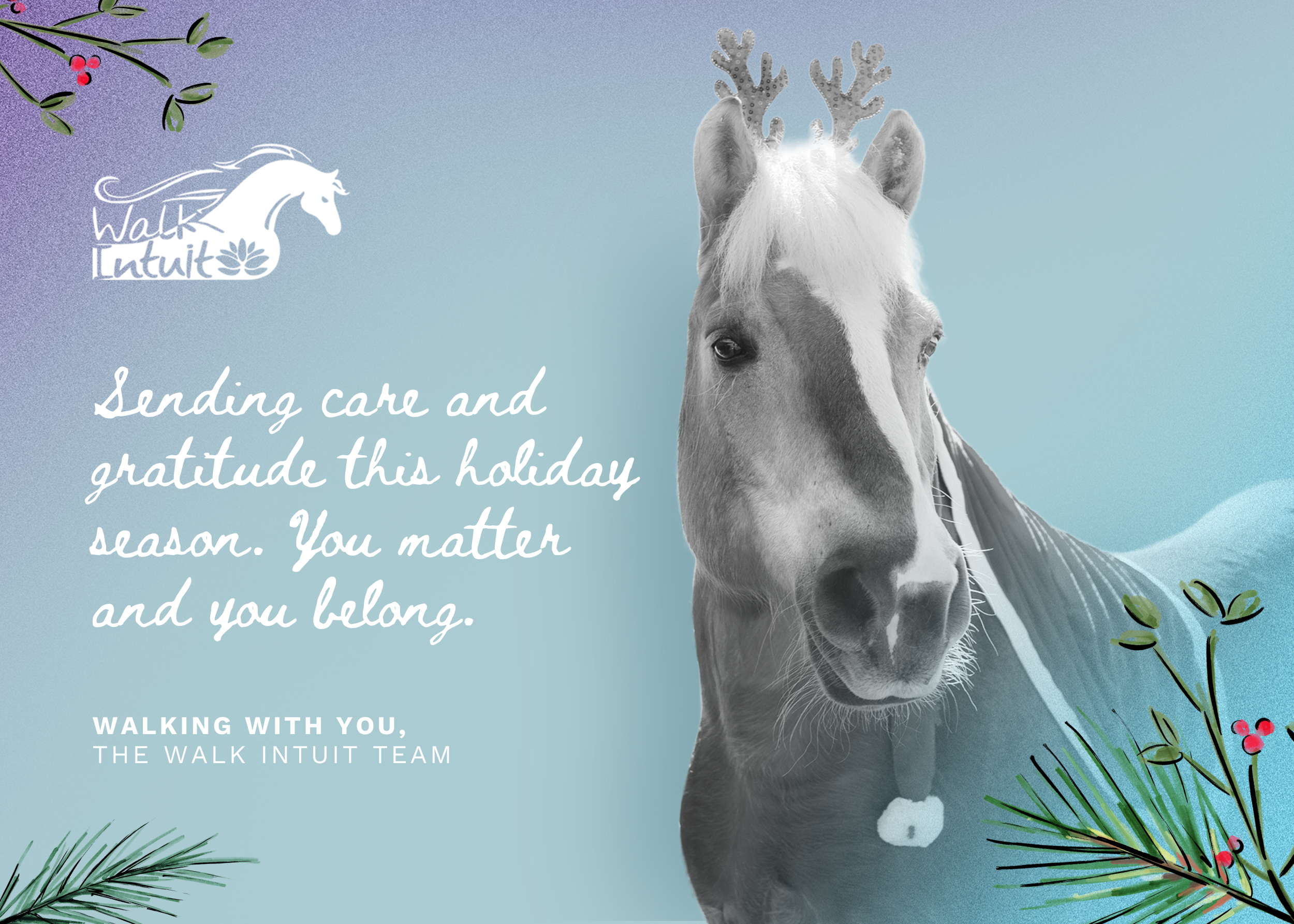
This is why spending time with animals, particularly horses, can be so profoundly regulating. Horses are prey animals that live in the present moment, constantly reading signals from their nervous systems. They don't care about your holiday stress, your political opinions, or your social media presence. They respond to who you are right now. That kind of honest, non-verbal connection can reset something deep within us.
The consistent practice here is asking yourself: What if nothing needs fixing? What if nothing has gone wrong? Whatever is present, good, bad, and ugly, can I anchor into what is stable and be here, be with? Sit with a pet. Walk in nature. Join a gathering where the focus is presence rather than performance. Notice what it feels like to simply be rather than do.
Whether you're surrounded by loved ones, feeling lonely, celebrating traditions, or trying to survive the season, you belong in the circle of care. You are worthy of connection, exactly as you are.
With tenderness and much love,
The Walk Intuit Team
Trauma-Informed. Intuitively Attuned. Clinically Grounded.
Sources and References
LifeStance Health. (2025). 2025 Holiday Mental Health Report. Retrieved from https://lifestance.com
American Psychiatric Association. (2025, November). Healthy Minds Monthly Poll: Holiday Stress. Retrieved from https://www.psychiatry.org/newsroom/news-releases
Frontiers in Psychology. (2025). Effects of mindfulness programs on college student well-being during life transitions. Retrieved from https://www.frontiersin.org/journals/psychology
Biomedicines. (2024). Neurobiological changes induced by mindfulness and meditation: A systematic review. Retrieved from https://www.mdpi.com/journal/biomedicines
Helliwell, J. F., et al. (2025). World Happiness Report 2025. Sustainable Development Solutions Network. Retrieved from https://worldhappiness.report
Social and Personality Psychology Compass. (2024). The relationship between prosocial behavior and well-being during life transitions. Retrieved from https://compass.onlinelibrary.wiley.com/journal/17519004
Royal Society Open Science. (2025). Spontaneous prosocial action and happiness in early childhood: A longitudinal study. Retrieved from https://royalsocietypublishing.org/journal/rsos
Disclaimer: This blog post is for educational purposes and does not replace professional medical or mental health treatment. If you are experiencing mental health challenges, please consult with a qualified healthcare provider.
